
If you assume that learning to speak Czech is difficult- you would be right. I have been working at it for two years now and am finally getting the hang of it. In the introduction to one of my Czech textbooks, the author marvels at how the Czech people have managed to keep their language alive and well during so many occupations of their homeland. He comes to the conclusion that it is due to their “Secret National Defense System,”
….. their language!

“I imagine that Czech was so difficult for the foreign invaders that they were unable to interact in a meaningful way with the Czechs”… and so they… “eventually tired of not being able to communicate much of anything, to anyone, they left, leaving the culture unaffected.” (401 Czech Verbs by Bruce Davies and Jana Hejduková)
The most difficult part of the language is its system of 7 different Cases in which nouns, adjectives, pronouns, and most numerals change their endings according to the Case used. The Cases define the relationship between words in a sentence, ie. who or what is the subject, direct object, or indirect object, etc. (Word order is not necessarily important in Czech but is crucial in English) For instance, here are some spelling changes for the word: doma which means home: “at home” is doma, “go home” jdi domů, “leave home” opustit domov, and “in the home” v domě.

I’ve made a few notes in my textbook! 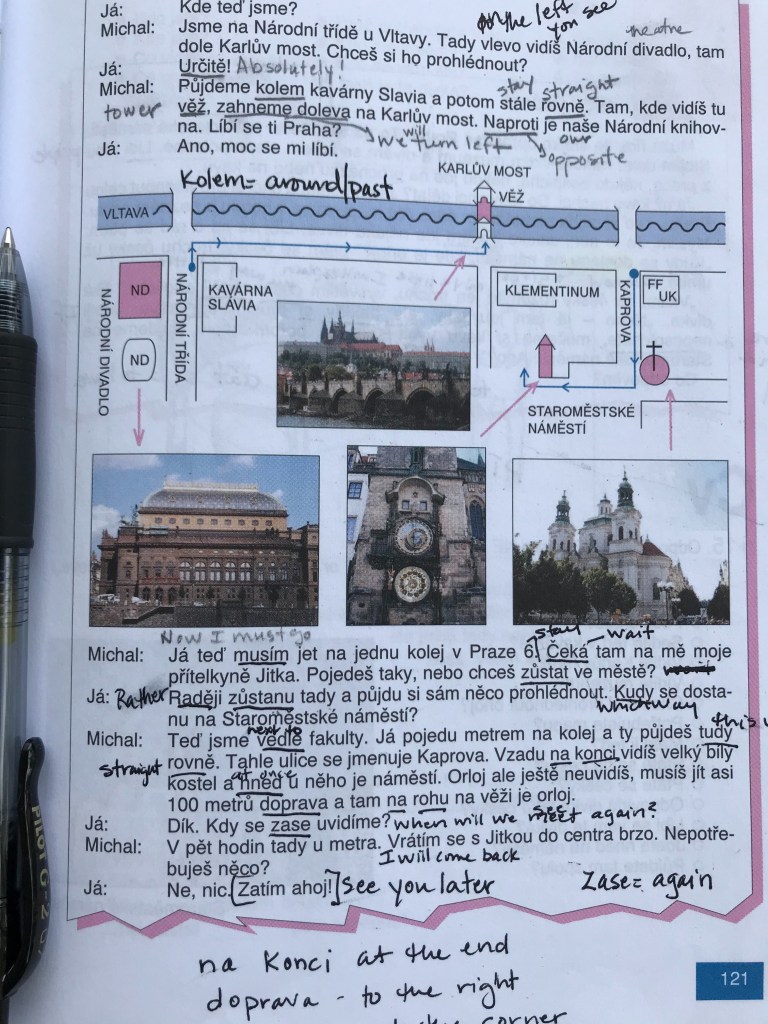
On the flip side, Czech is a phonetic language, which makes it easy to pronounce and spell- unlike English with all its silent letters like: “k” in knee, “b” in climb, “h” in hour, “w” in answer, and “gh” in thought. But more about the history and structure of English in another Post…
Did You Know That Queen Elizabeth I Spoke 9 Languages Fluently?
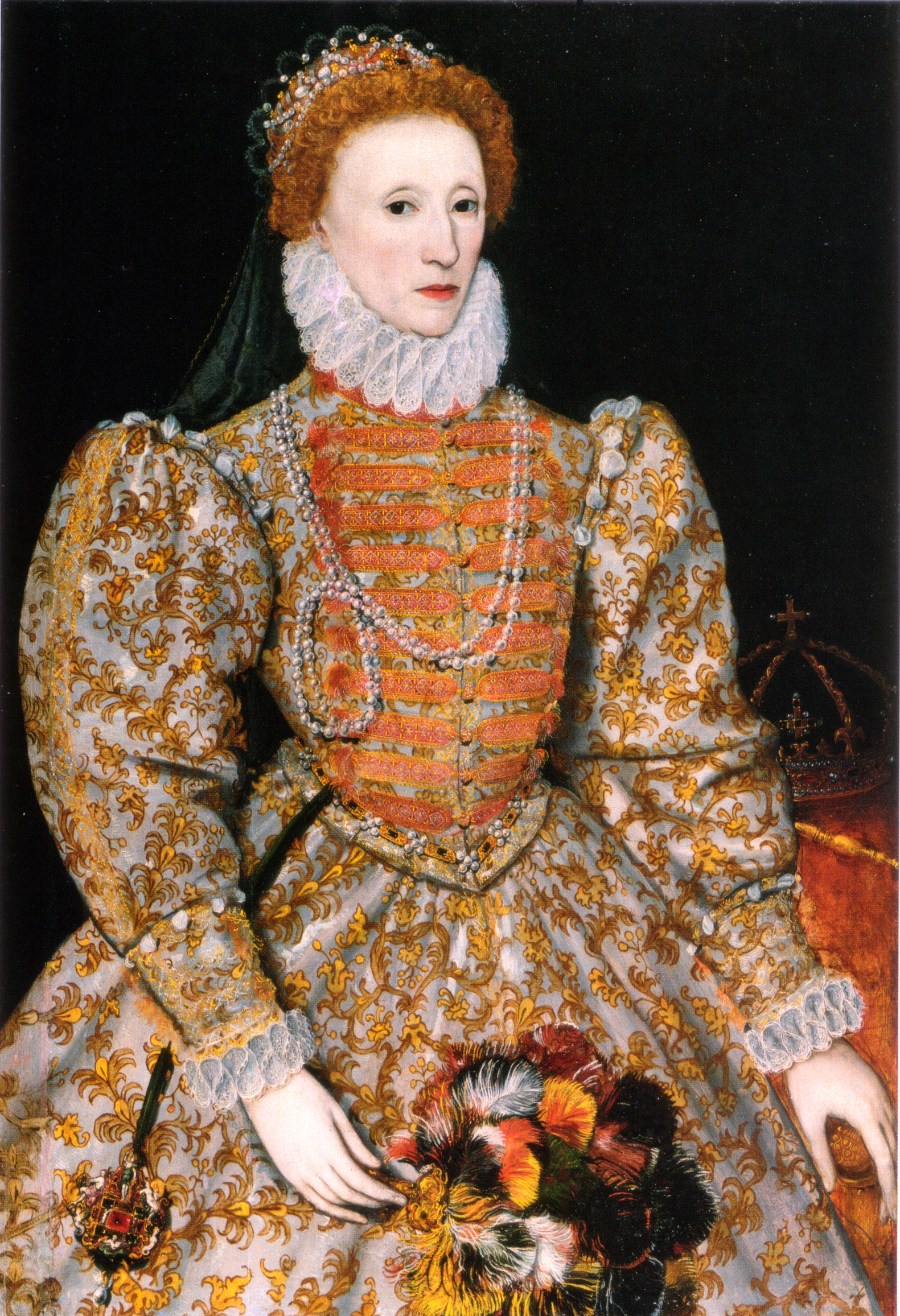
“She possessed nine languages so thoroughly that each appeared to be her native tongue; five of these were the languages of peoples governed by her, English, Welsh, Cornish, Scottish, for that part of her possessions where they are still savage, and Irish. All of them are so different, that it is impossible for those who speak the one to understand any of the others. Besides this, she spoke perfectly Latin, French, Spanish, and Italian extremely well.”
–Giovanni Carlo Scaramelli, Venetian Ambassador 1603
People often speculate as to which language is the most difficult to learn, usually assuming it’s the one that they speak. But difficulty is all relative. Relative to how similar the language is to your own (grammatically and phonetically), how well you learn in general, and of course, how motivated you are to learn it, among other things.


That being said, I checked out the Foreign Service Institute’s (FSI) ranking of world languages based upon their level of difficulty for native English speakers. The FSI provides training for U.S. foreign diplomats, so I figured they would know. They have divided languages into 4 categories with Cat 1 being easiest and Cat 4 labelled as “exceptionally” difficult. No surprise that Spanish and French fall into Cat 1 and that Arabic, Chinese, Japanese, and Korean are Cat 4. The bulk of the languages fall under Cat 3, which is where you will find Czech. (I won’t argue)
Of course, I am highly motivated to learn Czech as I plan to live and work in the country. But why should you learn to speak another language if you don’t plan to leave the U.S? Why should you be a polyglot (like Queen Elizabeth) and not a monoglot? Based upon my own experience, and with the help of Dr. Neel Burton, author of “ Beyond Words: The Benefits of Being Bilingual” (article appears in “Psychology Today” online July 2018), I would sum it up this way….

- It enriches your life. As Dr. Burton points out, multilingualism is closely linked to multiculturalism. As we investigate and learn another language we naturally come to know and appreciate that culture. Your understanding, empathy, and compassion will expand.
- It connects you to the world which is increasingly interconnected through the Internet and other technologies. Now more than ever before we travel, trade, and work with people and businesses around the world.
- It’s good for your brain health. Learning a foreign language is a great brain exercise that increases gray matter. It works the part of your brain that handles executive functions like analysis, problem solving, working memory, multi-tasking and attention control.

But, I suppose, there is a fourth, and very simple reason to learn a foreign language- it’s fun! How cool is it to be able to talk with another person in a second language? In my next post I will talk about tips for language study that have helped me.
Dear Readers, do you speak a foreign language? What has been your experience with learning another language? I’d love to hear about your language journey.








 This little anecdote has a parallel to another perceived passage of time that I’m experiencing right now. As I prepare and plan to make my move to

 Have you ever asked yourself the question, “What’s wrong with me?” I have. Usually I ask it while reflecting on something really dumb or unkind that I’ve thought, done or said. But there are also times when I ponder this question when comparing myself to other people. In particular, their career path compared to mine. How my jobs seem to have randomly wandered from field to field while other peoples’ seem to have been targeted toward a known end and stayed the course.
  Just as in the past, when I got my resume all organized and looked it over, I saw this meandering, very nonlinear work history that made me pause and say “What’s wrong with me?”
 But I’ve learned, (and truthfully, I’m still learning,) to embrace this uniqueness about myself. To see it as an asset and not a liability. To not ask, “what’s wrong with me?” but instead, “what’s right?” I have always been driven to explore, inquire, and learn in many fields, which has led me to multiple proficiencies. This is who I am, a Renaissance Woman.


 And then something happens over time. We work hard to create a comfortable world around us that is to our liking; our home, friends, activities, the work we do- they all become part of a rhythm of days that flows like a well-worn river bed. Life becomes more complicated too, and entangled with responsibilities. No longer can we simply “pack up and go.” Sometimes there is so much effort involved in getting away that we simply don’t. Pretty soon complacency begets inertia. And once again, we find that leaving home is not so easy to do for a whole new set of reasons.





 About a month ago I was in Chicago with a close friend to celebrate my birthday. My mother,
  traditional Czech bakery in Berwyn, the once ethnically Czech neighborhood where my grandparents had lived. The recent reviews on Yelp were promising; “one of the best bakeries in Chicago,” said one writer. “great old school bakery,” “my Grandma loved it,” wrote another. Riding the “L” and then taking a bus for the hour long trek to Vesecky’s, my mouth began to water with anticipation of the goodies we would find within.
 As I stood there sorely disappointed I attempted to reconcile fact with fantasy. Upon entering the bakery, there was no delicious aroma permeating the air characteristic of baking bread. On the contrary, there was a cold and sterile feel about the place. At first glance of the cookies and pastry behind the glass, my eye sent to my brain an image that did not match what I knew to be authentic, artisanal bakery. I realized that in my rush to conform reality to match my preconceived expectations I had set myself up to be disappointed.


 The Bohemian Freethinker